Terminal Tackle is what you put on the end of your line swivels, snaps, hooks and leaders. Artificial lures are what you use to imitate bait. Terminal tackle doesn’t sound like much but it can make the difference between going home happy and going home bummed out by the one that got away. The lures I’m going to talk about are my surefire go to lures. Stripers can be very fussy and very subtle changes in shape, action or color can make a big difference.
Terminal tackle:Barrel swivels and snaps- I usually make my own setups. The barrel swivels I use on big equipment can handle up to 90 lb test, the ones I use on light to medium equipment can handle 50lb test. I’ll never use that much on them but over kill in this area isn’t a bad thing. The very first thing I put on the end of any line is a barrel swivel snap combination. This makes it easy to change leaders and setups instantly. There are a lot of snap types but for making your own snap/swivels I like duolock snaps or Berkley crosslock snaps of the 2 the crosslocks are the best. Big stripers can trash must snaps when they get them in their mouths but I’ve yet to see them abuse a crosslock snap.

 Leaders-
 There are basically 2 types of leaders monofilament and wire. I make my own and vary the length and strength depending on the type of fishing I’m going to do. The wire leaders are usually about 1 ½ ft long made out of 50 lb test black coated wire. On one end I put a barrel swivel on the other end I put a crosslock snap. I like them relatively long because they are predominantly for blues and when I catch a blue I’ll generally pick it up by the leader and remove the hook over the side of the boat.

Stripers will not hit anything with a wire leader on it for that reason you need mono leaders on board. I used to make monofilament leaders out of regular monofilament but in the last few years my friend Paul has turned me on to fluorocarbon and I’m hooked. Fluorocarbon is really tough and abrasion resistant. I only use two different lb tests 60 and 20. Heavy tackle gets the 60; light to medium tackle gets the 20. I usually put

a barrel swivel and snap at either end, but often on the 20 lb test I’ll use the barrel swivel with just line to tie directly to the lure on the other end. The general rule for length is 3 ft that’s enough so the fish wont see the snaps and swivels.
Lures
Soft Plastics-Hands down the best baits for striped bass in the schoolie class 14-34 inches. These are deadly and what I use most for boat and shore schoolies. The problem is if there are blues mixed in they will get chopped up like confetti. For that reason I bring a bunch of them.
Zoom fluke- Lots of color choices a couple of different sizes 3” and 4”. Great lure for smaller stripers 14”-24” inches and sometimes big ones if their feeding on small bait. You can use them with a variety of jig heads. My favorites ¼oz-3/8oz jig head with smoking shad color or pearl color.
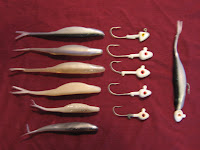
Cocahoe- Similar to a zoom fluke but has more of a fish like action. These are very effective in the early season along the coast. My favorite white cocahoe with white 3/8oz-1/2oz jig head.
 Storm Wildeye Shad- I’ve caught more 20”-35” stripers on these than any other lure. They are fabulous; the best colors are shad and blue. Unfortunately they no longer make the blue, but Calcutta makes one that I’ll be trying out this year. The best size is 4”, they can be cast and retrieved or jigged/bounced off the bottom. Stripers go crazy over them but like all plastics better have a lot of them because any blue will make a mess of them with just one hit. More and more companies are making this type of bait and they seem be here to stay.
 Swimmers -I almost exclusively use Bomber swimmers. They are tough and effective. They’re not usually as effective as soft plastics on stripers however blues cant chop them up. The only
  drawback is the number of hooks, be very careful when removing all those treble hooks. My favorites are the small 4” black backed silver side bomber for stripers and the medium 6” blue back silver side blue bomber for blues. They can be cast and retrieved or trolled. When all else fails and I can’t find fish I usually go to a flat along the western side of the bay and troll both bombers which ever gets hit first I go with. After dark late at night a totally black 6” bomber can also be very effective for stripers.
Buck tail jigs- They’ve been around since the stone age and they still work real ly well. They come in a variety of sizes and colors, but white is my favorite. They can be cast and retrieved or jigged off the bottom. You can sometimes substitute them for zoom flukes when blues are chopping up all your plastic. They are much more durable than plastic but blues will still shred them after quite a few fish. My favorite way to rig them is with a curly tail hooked on or with a piece of red or white pork rind (jig and pig).
Poppers-I love catching fish on top and poppers are the lure of choice for that kind of action. They come in a variety of colors and sizes. Most people use poppers that are way to big. I make my own and usually don’t fish any that are bigger than 4” long and ¾ “ diameter. Sometimes I’ll use poppers as small as 2 “ long with a 3/8 “ diameter. Stripers seem to love a silver body with a green back. When your fishing for stripers a buck tail attached to the back hook is really helpful. When it comes to blues color and buck tail is not that important just skim it fast and hang on. This is the most effective lure for blues when hey are near the surface.
 Live lining rigs- When it comes to live lining pogies I usually pre rig a bunch of
 barrel swivels, leaders and hooks before going out. I’ll put a barrel swivel at one end then 3ft of 60Lb test fluorocarbon then either a 5/0 treble hook or an 8/0 hook at the other end. Remember the line has a barrel swivel and snap at the end so if I need to change rigs fast or I want to put a cigar weight on to get the fish down I only have to undo the snap and replace the gear.
The secret weapon- This is real old school but some times you need to cast a relative light lure (zoom fluke, cocahoe, small buck tail jig, wild eye shad) a long distance. When fish are boat shy or when your fishing for shore this is the trick. Go to a craft store buy a wooden egg. Place a screw eye at each end or drill a hole straight through and use some plumber’s wire with a loop at each end (this is the strongest and best way). Put a small finish nail in the egg at an angle to act as a keeper for the lure. Tie a 3ft or somewhat longer piece of leader material to one end of the egg and tie any of the above lures at the other end connect it to the snap on the line and you’ll be able to launch things a mile.


